Agentic Software Engineering Consultancy

100% agentic software development

Engineering's bottleneck was never typing code — it's architecture, context and review. Autonomous agents removed the execution bottleneck. We execute for you, or we train your team to execute. Either way, the result is measured in your own repository.

  • Acceptance criteria defined before we start
  • Code, tests and documentation in your repository
  • No lock-in: full handover to your team

The new paradigm

Value shifted from those who execute
to those who orchestrate

For decades, an engineering team's delivery capacity was limited by the number of people able to write and review code. That constraint is gone. Leading companies already operate with lean teams multiplied by agents — and the question is no longer whether your engineering will adopt this model. It's who will lead it.

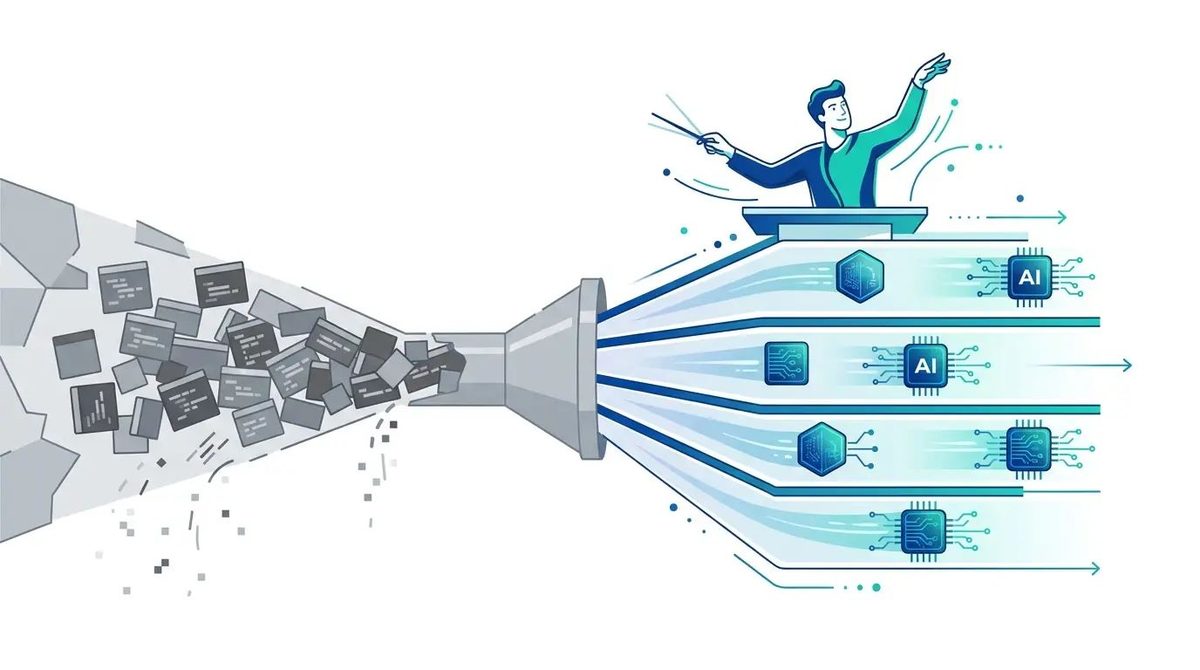
A chaos of disorganized code files passes through a funnel and comes out as orderly streams of AI agents, conducted by a maestro
The work is no longer producing every piece — it's conducting the whole.
01

Execution is no longer scarce

Autonomous agents plan, implement across multiple files, write tests, open Pull Requests and fix CI — in parallel and without line-by-line supervision. What used to be the center of engineering work became a commodity.
02

Humans moved up a loop

The engineer left the execution loop and entered the direction loop: deciding what to build, defining the context agents operate in and designing the quality system that validates the result.

03

Scale became orchestration

Increasing delivery capacity is no longer a function of headcount. It became a function of how many agentic streams technical leadership can direct, govern and audit safely.

The thesis

HIC — High Impact Contributor

The HIC is the engineer whose impact is no longer limited by their own execution capacity. They act as architect and tech lead of a team of autonomous agents that covers the full software lifecycle: specs, design, implementation, testing, code review, documentation, deploy and maintenance.

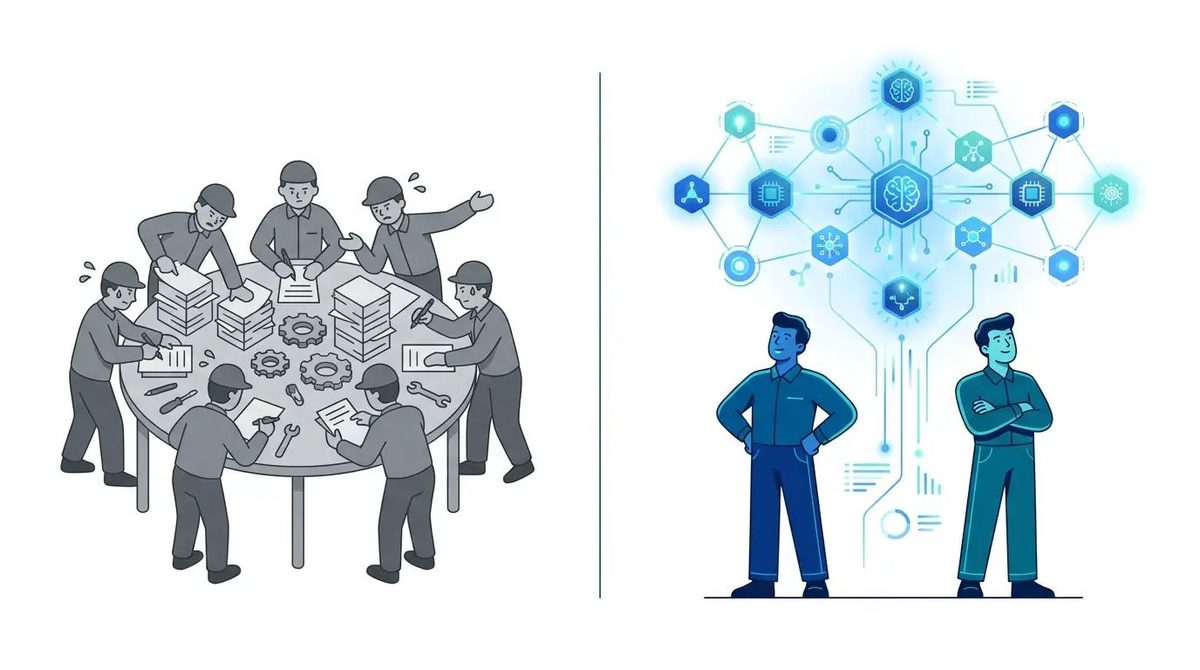
On the left, a large, overloaded traditional squad around a table; on the right, two calm engineers under a network of interconnected AI agents
The same workload: on the left, solved with people. On the right, with orchestration.

This is why 1 or 2 HICs sustain workloads that used to require entire squads: execution scales with orchestration, not with hiring.

An HIC is not the "10x engineer" who types faster. It's a new structural role: the tech lead whose team is mostly made of agents.

The 3 competencies of the role

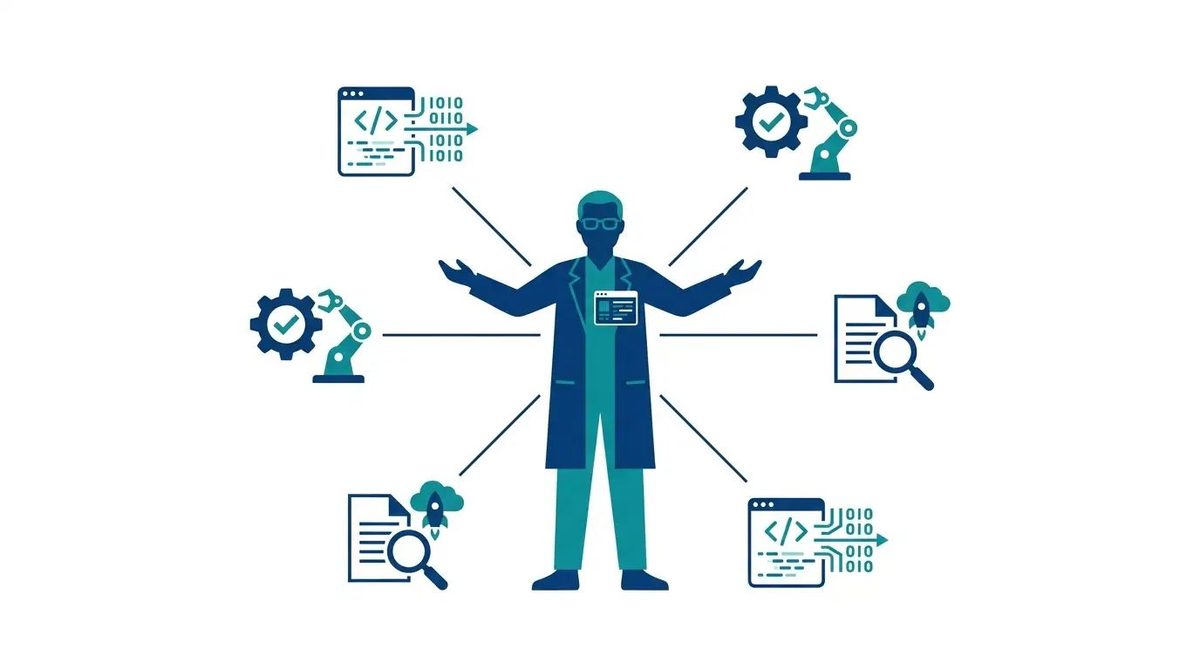
A professional at the center connected to icons of code, automation, verification and publishing, representing the coordination of the whole software lifecycle
1

Architecture and judgment

Deciding what to build, the system design and the trade-offs. Agents execute very well within a well-defined context — defining that context is high-level human work, and it's the HIC's first differentiator.

2

Context engineering and specification

The new "knowing how to code": writing specs, standards and system knowledge so that agents implement it right the first time. The spec became the contract; code became the consequence.

3

Governance and auditing

Defining quality gates, permissions and where human review is non-negotiable. The HIC doesn't review every line — they design the quality system that reviews for them.

How it works

The software lifecycle,
operated by autonomous agents

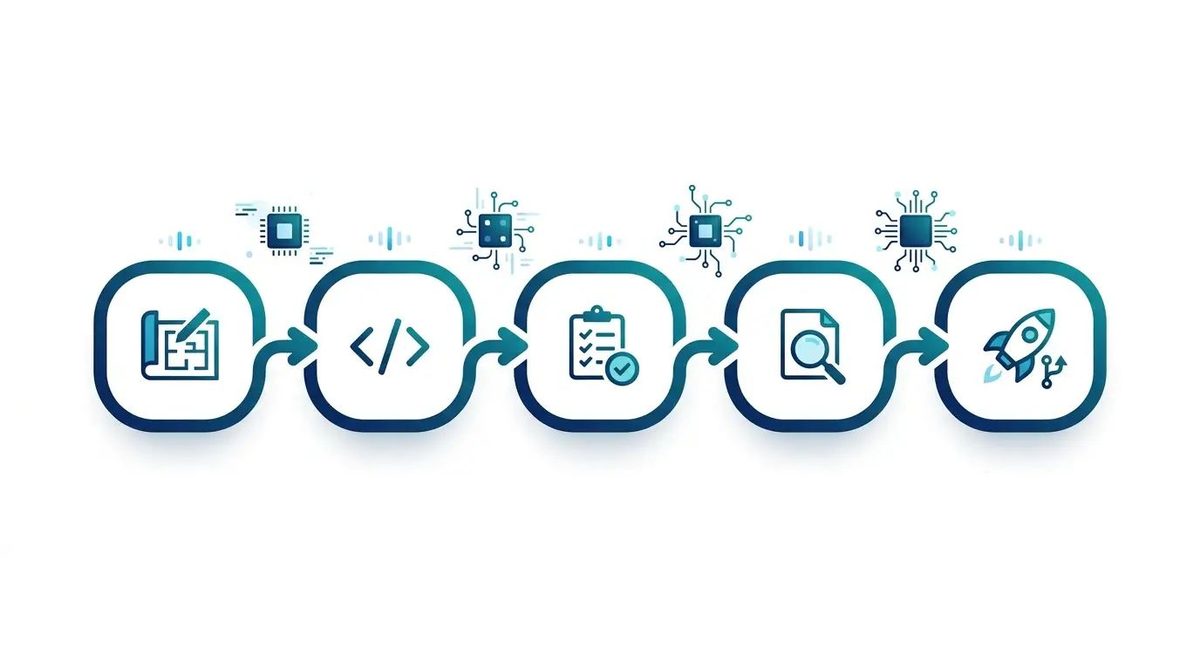
This isn't "using AI to autocomplete". It's a pipeline where each SDLC stage has a responsible agent, an input contract and a quality gate on the way out — with human decision points defined by design, not improvised.

Five chained software lifecycle stages — plan, code, test, review and publish — each assisted by an AI chip
  1. Spec

    Specification and context

    The requirement becomes an executable spec: scope, acceptance criteria, repository standards and architecture constraints.

    Human direction
  2. Plan

    Planning

    The agent breaks the spec into an implementation plan, maps the impacted files and surfaces risks before writing code.

    Agent
  3. Build

    Implementation

    Parallel multi-file execution, following the repository's own standards and the project's spec library.

    Agent
  4. Test

    Testing and verification

    Tests generated by default alongside the feature — not as debt to be paid later. If it fails, the agent fixes it and runs again.

    Agent
  5. Review

    Automated code review

    Quality gates, adversarial review by agents and security checks before any human eyes are spent.

    Agent
  6. PR / CI

    Pull Request and integration

    PR opened with context and traceability; the agent follows CI and fixes whatever breaks until the pipeline is green.

    Agent
  7. Gate

    Approval and governance

    The HIC decides what is non-negotiable for human review: sensitive changes, security surfaces and architecture decisions.

    Human direction
  8. Run

    Deploy, documentation and maintenance

    Documentation updated as a by-product of the flow, governed deploy and maintenance with triage and fix agents.

    Agent

What changes in practice

Traditional squad vs HIC model

Comparison between the traditional squad and the HIC model
Metric Traditional squad HIC model
Feature lead time Weeks Hours
Code review Senior engineers' bottleneck Automated with quality gates
Tests and documentation Always behind Generated by default in the pipeline
Senior capacity Consumed by manual review Freed up for architecture
Delivery scale Hire more people Orchestrate more agents

Less technical debt

Tests and documentation stop being the first thing cut under deadline pressure.

Fewer incidents

Quality gates applied consistently across every delivery, not only when there's time.

Seniors in the right place

The company's most expensive capacity goes back to architecture and decision-making, not manual review.

Predictable delivery

Scaling no longer depends on hiring, training and waiting for new people to ramp up.

Two ways to work with us

We do it for you.
Or we teach your team to do it.

There's no single right answer for every company — there's the right answer for your moment. If the pressure is to deliver now, start with execution. If the goal is to change your engineering permanently, start with training. Many do both, in that order.

Execution · we deliver

Agentic Squad with a Guarantee

"Want us to migrate your legacy or ship your ideas?"

A squad of autonomous agents led by a NextLearn HIC takes on the work and hands it back running in production.

  • You don't need to hire or train anyone right now
  • Acceptance criteria defined before the first line
  • Results in weeks, not quarters

Training · your team delivers

HIC Program — 10 weeks

"Want your engineering to start operating this way?"

An intensive immersion plus guided implementation, with a real pilot running inside your own repository.

  • The capability stays installed and doesn't depend on us
  • Playbook, specs and quality gates stay with the company
  • Wrap-up with a result measured against the baseline

Agentic Squad with a Guarantee

Want us to migrate
or ship your ideas?

Every tech company carries the same two things: a list of ideas that never leaves the page and a legacy system nobody wants to touch. Years of meetings, prioritization and roadmaps solved neither — because the problem was never willingness. It was execution capacity.

An agentic squad doesn't have that limit.

Migrate the legacy

"Only one person understands that system. No tests, no documentation, and every new delivery runs into it. Rewriting is too expensive and too risky."

Agents read the entire system — not a sample — rebuild the documentation that never existed, cover current behavior with characterization tests and only then migrate, piece by piece and with the system live. Knowledge leaves one person's head and becomes a company asset.

Ship your idea

"The idea is validated, the customer wants it, the business needs it — but there's no one available. It's been in the backlog for three quarters waiting for someone to free up."

New product, integration, automation, that module that never had a team: from spec to deploy with the same governance as the HIC model. You follow progress in Pull Requests in your repository, not in status slides.

How it works, from first contact to delivery

  1. Diagnosis

    We look at the code, the environment and the real problem. You walk away with a technical assessment — even if you decide not to proceed.

  2. Scope and acceptance criteria

    What "done" means is written and agreed before we write the first line. That document is what the guarantee covers.

  3. Agentic execution

    The squad runs the full pipeline — plan, build, test, review, PR — under an HIC's direction and the agreed quality gates.

  4. Delivery and handover

    In production, tested and documented. Your team gets the full handover and takes over whenever it wants.

The guarantee, in plain English

We define the acceptance criteria together before we start. If the delivery doesn't pass those criteria, we redo it. If it still doesn't pass, you don't pay for it. The execution risk is ours — not yours.

  • Criteria written before the code. No "that's not what I understood" at the end of the project.
  • Your code is yours from the first commit. We work in your repository, with your permissions and audit trail.
  • Tests and documentation come with it. They're not extras billed separately, they're part of the definition of done.
  • No lock-in. Every squad ends with a handover. If you want to take over later, that was always the plan.

Scope, timeline and commercial terms are defined per project, at the diagnosis — because guaranteeing a result requires understanding the problem before promising anything.

What people usually ask before signing

What about the quality of code written by agents?

It goes through the same quality gates we design in the HIC model: tests, adversarial review by other agents and security checks, defined together with you before we start. What doesn't pass the gate doesn't become a Pull Request. And what does, an HIC signs off on.

What about the security of my code and data?

We operate inside your environment, with the permissions you grant and a full audit trail of everything done. You define where human review is non-negotiable — and nothing gets past those points without approval.

My system is too old and complex. Does it really work?

Old systems are exactly where the gain is largest: the cost of understanding the code is what stalls these projects, and that's precisely what agents do fast. We start with a small, verifiable slice, so you can see the method working before scaling up.

What if I want to bring this in-house later?

That's the best possible outcome — and the path already exists: your managers join the HIC program and start operating the same model. We don't live on dependency, we live on results.

Describe your project in two lines

If it's not for us, we'll say so. If it is, you get the scope and acceptance criteria before taking on any commitment.

Talk about my project

HIC Program · training

Immersion + guided implementation

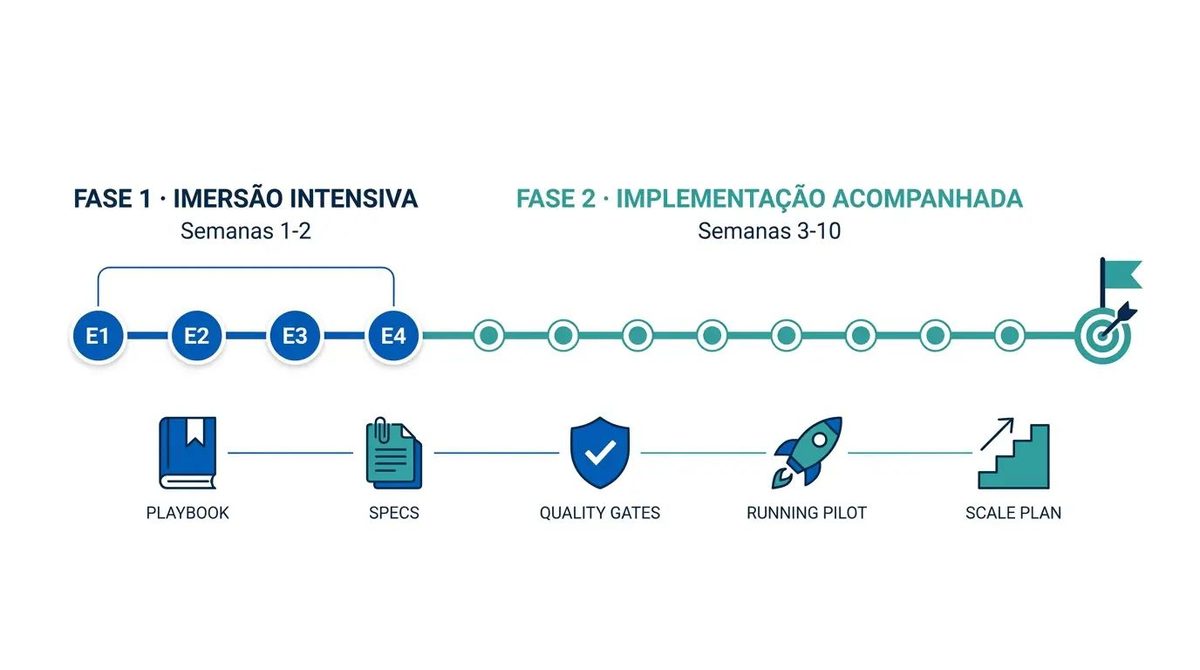
A 10-week program for cohorts of up to 6 managers, starting within 2 weeks of signing. It's not a course: by the end of week 2 your team already operates the HIC model, and the following 8 weeks exist to secure the result inside your own environment.

Program timeline: phase 1 immersion with sessions S1 to S4 in weeks 1 and 2, followed by phase 2 guided implementation through week 10, with deliverables playbook, specs, quality gates, pilot and scale plan
Phase 1

Intensive immersion

Weeks 1–2

The whole method delivered in 4 live 3-hour sessions.

  1. S1

    The agentic paradigm and the HIC role

    Why engineering's constraint moved, what defines the High Impact Contributor and how to reposition the team around that role.

  2. S2

    Agentic architecture in the SDLC + stack

    Code agents, MCP, spec engineering and integration with Git and CI/CD — the stack that sustains real agentic operation.

  3. S3

    End-to-end autonomous pipeline

    plan → implement → test → review → PR: how to build, measure and debug the flow where agents deliver with real autonomy.

  4. S4

    Governance, quality gates and security

    Permissions, auditing, where human review is non-negotiable — and defining the pilot with the baseline to be measured.

Phase 2

Guided implementation

Weeks 3–10

The method leaves the classroom and enters the company's repository.

  • Real pilot led by 1–2 HICs operating with agents on a production workload of the company itself.
  • Weekly live checkpoint (1h) to unblock, tune the pipeline and review architecture and governance decisions.
  • Direct channel with the mentor throughout the period, for decisions that can't wait for the next checkpoint.
  • Wrap-up with a measured result in your own repository, against the baseline defined in session 4.

What's measured at the end is what was really happening in your code — not a training simulation.

Deliverables

HIC Playbook

The method documented and adapted to your engineering's context, stack and constraints.

Spec and template library

Specs, standards and agentic workflow templates reusable by the teams from the next day on.

Quality gates framework

The quality gates, permissions and human review criteria that make autonomy safe.

Running pilot

An agentic flow operating in your environment, with a result measured against the initial baseline.

Scale plan

The path to take the model from the first squad to the rest of the organization.

Installed capability

Playbook, templates and mastery of the method stay permanently in the company — they don't depend on the consultancy.

Who it's for

Built for those who own delivery

  • CTOs and Heads of Engineering who need to grow capacity without growing headcount at the same rate.
  • Teams with a critical legacy that blocks every new delivery and that no one wants to take on.
  • Companies with validated ideas stuck in the backlog for lack of available people.
  • Managers who have already tried AI tools on the team, but haven't turned it into a structural gain.

When it's not

It's not for everyone

  • Those looking for a theoretical AI training, with no intention to change how the team operates.
  • Projects with no possible objective acceptance criteria — without that, there's no guarantee to offer.
  • Contexts where technical leadership has no mandate to change the review and CI/CD process.

Who leads it

About NextLearn

Founded in 2023, NextLearn was born to create education solutions and digital environments that use Artificial Intelligence to solve complex problems with real impact. Today we apply that same repertoire inside engineering teams: turning software teams into high-performance agentic operations.

Deivid Bitti, founder of NextLearn

Deivid Bitti Founder

A Computer Scientist specialized in AI, Cybersecurity and high-scale architectures, with over 20 years of experience in digital transformation. He founded Flexa Cloud — a company specialized in cloud computing, Big Data and AI, and an AWS Advanced Partner — after a career in large corporations.

Specialized in Generative AI at MIT, he serves as an advisor and executive helping companies transform industries through Artificial Intelligence.

  • +20 years in digital transformation
  • Generative AI · MIT
  • Founder of Flexa Cloud
  • AWS Advanced Partner
Discover Deivid Bitti's work and publications deividbitti.com
CIO Review LATAM magazine cover with Deivid Bitti, CEO, and the headline Building Intelligence That Moves Industries Forward

International recognition

Deivid was the cover of CIO Review LATAM, a publication with hundreds of thousands of subscribers in the United States and Latin America, in an edition about building intelligence that moves industries.

In the same edition, Flexa Cloud was recognized as Top AWS Generative AI Services in Latin America 2025, after evaluation by a panel of C-level executives and the magazine's editorial board.

Next step

Start with the diagnosis

A conversation to understand your stack, your problem and where the real bottleneck is. From it, you get the delivery slice and the acceptance criteria — before taking on any commitment.

  • 1 Diagnosis of the problem, the code and the environment
  • 2 Scope, acceptance criteria and baseline to be measured
  • 3 Proposal and timeline for your context

Request contact

We reply within 1 business day. Your data is used only for this contact.